Tang Soo Do History
It could be said that the origins of martial arts date back to the beginning of humanity, when human existence depended on one's ability to defend themselves.
In ancient times, all cultures have at some point used traditional combat skills both for fighting tribal wars and for self-defense against animal attacks. Through the refinement of these methods, unique hand and foot movements developed that can be called martial arts.
Ancient Korean Martial Arts
However, the origins of Tang Soo Do can be traced to the period when three kingdoms ruled Korea:
- Shilla (Silla) 57 BC to 935 AD,
- Paekjae (Baekje) 18 BC to 660 AD and
- Koguryo (Goguryeo) 37 BC to 668 AD.
Many Tang Soo Do (Soo Bahk Kee) relics have survived from this time to the present day. One of the most famous is the Koguryo wall painting depicting martial arts and is approximately 1500 years old. It was found in tomb drawings in the lower reaches of the Ap Rok River (also known as: Aplok, Amrok or Yalu), which is part of the modern North Korean and Chinese border. The Koguryo royal tomb paintings depict the lifestyle of that time. One of the tombs, discovered in 1935-1940, depicts a scene where two soldiers are engaged in hand-to-hand combat.
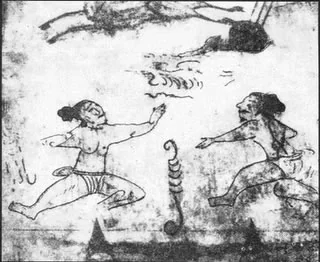 Koguryo wall painting
Many Shilla Buddhist sculptures depicting monks practicing martial arts have also survived to this day. The guardians Inwang Yoksa (Kumgang Yoksa), carved at the entrance to Sokkuram Grotto (Seokguram Grotto), depict a stance that is also found in Tang Soo Do.
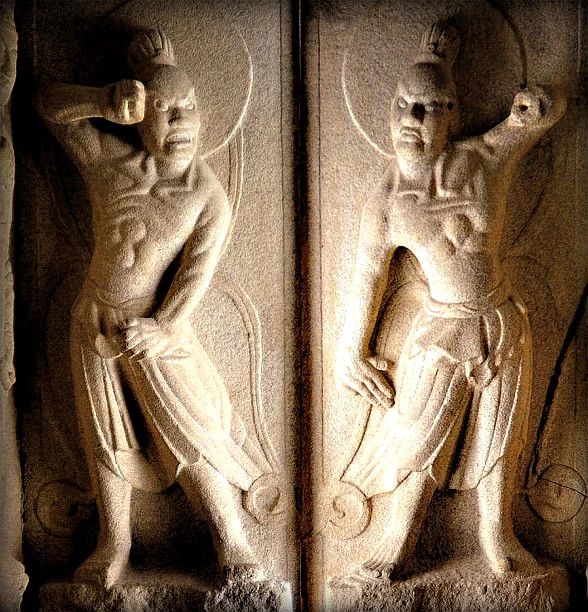 Seokguram Grotto guardians - Inwang Yoksa
Historical Reference (Koryo Dynasty)
A record found in volume 18 of Koryo (Goryeo, Ko Ryo) history - dated around 1100 AD, mentions We Moon Lee, whom King E Jong (Ui Jong, Yejong - 16th Koryo dynasty (918-1392 AD) monarch) appointed to the position of army commander specifically because of his expertise in martial arts and use of Tang Soo Do for fitness training purposes.
Times of Change
Until the end of the Yi dynasty (1907), various martial arts and their forms were practiced in Korea. The training of these arts was interrupted in Korea during the Japanese occupation, which ended in 1945, when the modern development of Tang Soo Do also began.
Modern Tang Soo Do Birth and Development
Grandmaster Hwang Kee (1914-2002)
Modern Tang Soo Do development occurred with the help of Grandmaster Hwang Kee, who founded Mo Duk Kwan (Korean Martial Arts Academy) in November 1945.
Kwan Jang Nim Hwang Kee was born on November 9, 1914. His first encounter with martial arts was at the age of seven, when he had the opportunity to observe a man who defeated several attackers using only his hands and feet. He followed the man home and, watching the man, tried to imitate his hand and foot movements. One day the boy gathered courage and asked the man to teach the little boy, but the man refused, saying the boy was still too young. Despite this missed opportunity, the boy couldn't forget what he had seen and continued to repeat the movements he had observed.
In May 1936, while working at a railway company in Manchuria (region in Northeast Asia), Lee met Master Yang Kuk Jin. After several requests, Lee and his friend Park were accepted as students.
Moo Duk Kwan Philosophy
After the end of World War II in 1945, Grandmaster Hwang Kee established Mo Duk Kwan, which translates to "Institute of Martial Virtue". His intention was to improve the quality of life through martial arts. His philosophy was based on Taoist natural view (all things in nature are connected), Buddhist value system and Confucian ethical principles (relationships with parents, higher powers, daily behavioral etiquette and attitude toward social and political institutions). In the midst of all this were also the fundamental principles of elite soldiers, created by Buddhist monks several centuries ago. He also believed that a martial arts practitioner must be educated.
Significance of Hip Turn
Another important element in Tang Soo Do is the hip turn (kihap). It allows generating and giving greater power to each movement. Grandmaster Hwang Kee recognized it as very useful and thus almost every movement in Tang Soo Do includes this hip turn element, with the idea that by applying less effort, a greater effect could be achieved.
The hip turn is a small movement with potentially great power.
Early Development and Challenges
Hwang Kee initially used "Hwa Soo Do" (flower hand path) to describe his martial art, but unfortunately this attempt was unsuccessful. As early as 1947, he began teaching Tang Soo Do (Mo Duk Kwan) (Tang was a more widely used term specifically in Korea).
Unfortunately, on June 25, 1950, the Korean War began. Grandmaster Hwang Kee had to relocate and continue conducting training in South Seoul. In 1951, he conducted training in Pu San city, Cho Ryang railway station. After the war, in 1953, he returned to continue teaching training in Seoul, and in 1955 he could afford to rent a building located opposite the central station. This building became the legendary "Joong Ang Do Jang" (Central Training Hall). At this time, Grandmaster Hwang Kee also began developing martial arts and, driven by purely scientific purposes, incorporated the hip turn into each movement to increase the effectiveness of each movement.
Police, schools, as well as military personnel - all sought Tang Soo Do instruction and as a result, new training halls continuously opened in Korea. The Mo Duk Kwan system was also taught at the Navy and Air Force academies in Korea. At this time, American soldiers in the region also began regularly attending martial arts training.
Awareness of Historical Roots
In 1957, Grandmaster Hwang Kee discovered Mo Yei Do Bo Tong Ji. It is the oldest and most valuable historical documentation of ancient Korean martial arts, known as "Soo Bahk". He spent many years interpreting the texts and trying to understand their meaning.
On June 30, 1960, Grandmaster Hwang Kee included Moo Duk Kwan in the Korean So Bahk Do Association as a traditional Korean martial art.
Fight for Identity
In May 1961, discussions began about uniting all Korean martial arts schools under one name. Moo Duk Kwan was the most successful of the schools and was offered to take 3 places out of 21 total board director positions and name the new organization Tae Kwon Do. Grandmaster Hwang Kee refused to participate in this unification process because he believed that Soo Bahk Do is a traditional Korean martial art.
At this time, pressure on Tang Soo Do increased and many organization members switched to the newly created Tae Kwon Do. There were also attempts to force the closure of the Soo Bahk Do Association. In 1965, Grandmaster Hwang Kee filed a lawsuit against the Korean government. He won the court case in November 1965, and the future of Soo Bahk Do was secured, but the government continued the fight in the Supreme Court in January 1966. And in June 1966, the Supreme Court ruled in favor of Grandmaster Hwank Kee. This turn of events allowed him to lead his organization without any external interference and continue work on the organization's restoration.
International Expansion and Grandmaster Kang Uk Lee
Grandmaster Kang Uk Lee, who has now reached the tenth dan, is currently the oldest student of Hwank Kee. Thanks to Grandmaster Lee, Tang Soo Do is also known in the United Kingdom and Southeast Asia since the 1970s. Grandmaster Lee's inspiration and guidelines were the instruments that helped popularize and introduce Tang Soo Do in Europe. And only thanks to Grandmaster Lee's persistence has modern Tang Soo Do become a global organization.
By the 1970s, the consequences of litigation had subsided and Mo Duk Kwan continued to expand in the United Kingdom, USA, Greece, Germany, Belgium, Italy, Switzerland, Netherlands, Puerto Rico, Argentina, Malaysia, Brunei and Australia.
In 1974, the United Kingdom Tang Soo Do Federation was founded as the designated branch of Korean Soo Bahk Do. It was led by Grandmaster Kang Uk Lee, at that time the seventh Dan. In 1979, he was promoted to eighth Dan and later in 1989 he founded his own organization.